 Meditation · Mindfulness · Enlightenment
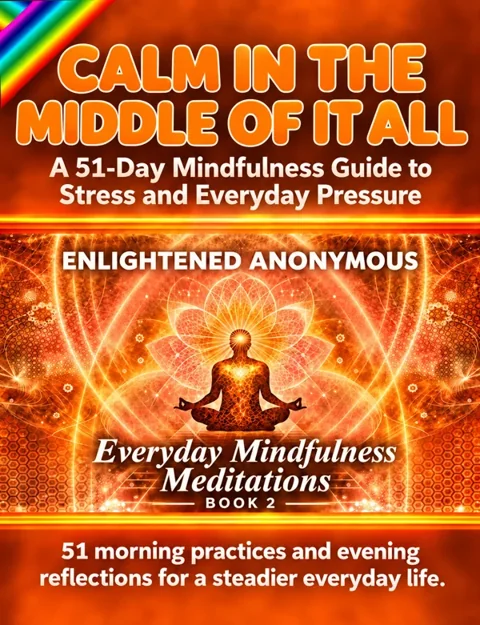
Everyday Mindfulness Meditations · Book 2
Calm in the Middle of It All
A 51-Day Mindfulness Guide to Stress and Everyday Pressure
51 days of reflection on workload, overwhelm, boundaries and realistic limits.
Read the first day → · Read or listen
About this book
When everything feels urgent, a little clarity can change what you do next. Calm in the Middle of It All is a 51-day mindfulness guide to stress and everyday pressure. Through brief morning practices and evening reflections, it invites you to examine the demands you carry, the promises you make, and the small transitions that shape a crowded day.
Work, household responsibilities, difficult messages, interruptions, and changing plans all become places to practice. Start by naming the load rather than treating it as a vague feeling that you should somehow manage better. Notice which deadlines are real, which expectations can be clarified, and which responsibilities can be shared.
The book pairs moments of attention with practical choices, helping you consider when to pause, when to ask, and when an arrangement needs to change. Across the 51 days, you will explore how to: Recognize pressure in your language, body, calendar, and automatic agreements. Build short arrival rituals and leave useful margins between tasks.
Estimate time more honestly and ask what should take priority when demands compete. Take a break that meets an actual need, such as food, movement, rest, or company. Make a clear request, prepare a handover, and accept help without taking the task back.
Identify early warning signs and create a practical plan for the next busy period. You might reconsider a hidden yes, give a meeting a clearer ending, or distinguish another person's urgency from your own responsibility. A difficult email becomes a chance to separate the request from the pressure in its tone.
A difficult week can show which commitments need more time or support. The book contains 51 morning practices and 51 evening reflections. Allow a few minutes for each reading, try the practice in a suitable situation, and return to the questions later.
Write a brief note or reflect quietly. You can repeat, shorten, or adapt a practice. As you continue, the book explores perfectionism, availability, crowded households, unfinished conversations, and the pressure people pass to one another.
Recovery receives attention too: what happens after the busy period, what ordinary maintenance has been postponed, and what deserves protection even when the schedule is full. Rest and realistic limits have a place alongside effort. You will also examine the difference between making a task easier to face and changing a task that asks too much.
Mindfulness can help you see the situation more clearly, including its practical constraints. Sometimes the next helpful step is an unhurried breath. Sometimes it is a smaller promise, a conversation about workload, or permission to stop carrying a responsibility alone.
Written for readers balancing competing demands, this book offers an approachable daily practice without requiring previous meditation experience. The examples stay close to work, home, travel, and shared responsibilities. You can begin wherever pressure is most visible and keep the changes that prove useful in your circumstances.
The evening reflections help you review the demands you accepted and the pressure you passed on. You can notice whether a hurried instruction left someone else guessing, whether a break met your needs, or whether a promised deadline was realistic. Daily mindfulness for stress becomes a way to examine your arrangements as well as your reactions.
Shorter versions of the practices are included for days when a long pause is unavailable. You will also consider the standards behind your effort: what genuinely needs care, what can be good enough, and which ordinary part of life deserves protection during the next surge.
Themes in this book
- Mindfulness for everyday stress
- Workload pressure
- Realistic limits
- Overwhelm
Read at your own pace
This volume is arranged as 51 days of morning practice and evening reflection. You can begin with one entry, try a manageable exercise, and return to the questions later. Repeat or adapt a day when that is useful.
Interested in a short practice first? Try a free written practice →
OPEN THE BOOK
Read the first day
A morning reading and its evening reflection.
DAY 1 · Morning
The load you carry
Rest can support a return to life. A crowded day often treats recovery as whatever remains after every other claim has been met. Yet the person making the promises also needs time to eat, travel, and arrive. Counting those conditions is part of understanding a day, rather than an admission that you have failed to manage it.
Before accepting another task, write everything already asking for your time. Include travel, care, meals and recovery. A day has limits even when a list does not.
DAY 1 · Evening
The load you carry
Which demand disappeared from view until you counted it? What deserves a more realistic place tomorrow? Write one adjustment in tomorrow's calendar before closing the list.
Explore the opening seven days
- The load you carry
- Name the pressure
- An arrival ritual
- Your pressure vocabulary
- The hidden yes
- Two speeds
- Read the week honestly
Read or listen
Ebook
For your reading app or device.
Links coming soon
Paperback
A printed copy to keep close.
Links coming soon
Hardcover
A case-bound edition for your shelf.
Links coming soon
FROM READING TO EVERYDAY LIFE
Read. Pause. Practise. Reflect.
Take a passage into your day. This companion invitation is optional; you can adapt it or stop whenever you wish.
A little is enough.
Read the opening sample slowly. Choose one idea to consider rather than trying to retain everything.
Read the sample →Make room to notice.
Choose one small task and attend to its first movement.
Try it in context.
Explore a related practice, then notice whether anything feels useful in an ordinary moment.
Open the related practice →Keep your own question.
What helped you return to this task?
Read and make an optional note →