 Meditation · Mindfulness · Enlightenment
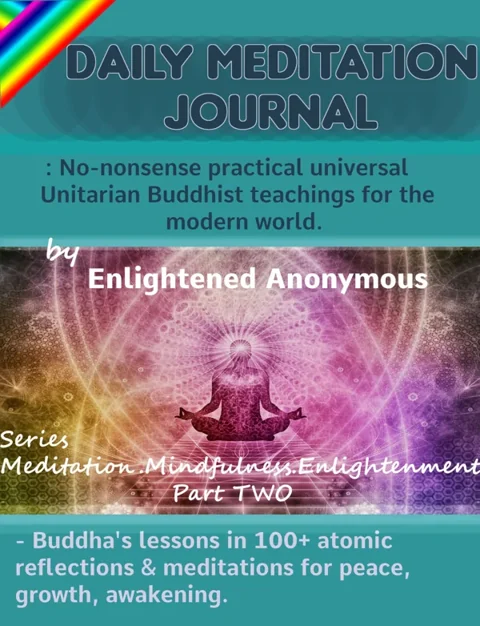
Meditation, Mindfulness & Enlightenment · Book 2
Daily Meditation Journal
No-Nonsense Practical Universal Unitarian Buddhist Teachings for the Modern World.
Make time for personal reflection with a meditation journal.
Read the first day → · Read or listen
About this book
How can Buddhist teachings become something you notice and practice during an ordinary day? Daily Meditation Journal presents short morning and evening readings on Buddhist ideas and meditation practice. The sequence begins with the Noble Eightfold Path and returns to attention, intention, suffering, and awakening through familiar questions about how we live.
The title refers to a daily reflective companion: this is a book of readings, rather than a blank notebook. There are 51 main days of paired morning and evening readings, followed by two bonus entries on Day 52: 104 readings in all. The form gives you a place to start each morning and a second encounter later in the day.
You can follow the sequence or return to a subject that is relevant now. The opening entries introduce right understanding and the nature of mind, then turn to the tendency to find fault, the effort needed in practice, and the changing conditions of life. Teachings on impermanence and dependent origination appear beside observations about posture, thoughts, and conduct.
You can meet the concepts one at a time, without treating a brief entry as a complete explanation of Buddhism. Later readings examine balance in meditation, calm, discomfort, anger, shame, and the ways we react to difficulty. Attention becomes a practical subject: where does it go, what brings it back, and what expectations have you placed on a sitting?
A short reading can give you a question to carry into an activity you already do. The book also considers karma, intention, identity, and factors for awakening. These are presented within the book's spiritual perspective.
Readers can examine the teaching, consider their own interpretation, and return to the actual choices that follow. Learning a term and understanding its effect in your day are different parts of the inquiry. Subjects you will encounter include: The Noble Eightfold Path, right teachings, and the Four Efforts.
The Five Remembrances, dependent origination, and changing experience. Mindfulness of postures, bare attention, and meditation balance. Working with thoughts, anger, discomfort, and difficult periods of practice.
Intention, karma, insight, and questions about awakening. Allow two to five minutes to read and consider an entry. Take more time if a passage raises a useful question.
A short reading can open a longer sitting or accompany a quiet pause; the length of the entry does not set a limit on your own observation. The morning and evening passages approach the day’s subject from different angles. Individual readings include “Noble Eight-fold Path”, “Illusion?”, “Anger Time”, “Brain Forgets”, “Factors for Awakening”.
These titles show the range of the sequence and give you subjects to revisit after a first reading. The paired form allows the second reading to meet a day you have actually lived. You may notice an assumption, a reaction, or an example that makes the earlier passage more concrete.
If you keep notes, a few honest words can be enough. Return to what happened rather than trying to produce an impressive account of progress. Daily Meditation Journal is Book 2 in Meditation, Mindfulness & Enlightenment by Enlightened Anonymous.
It can be read independently. The series brings together concise meditation ideas, spiritual perspectives, and questions for self-discovery, with room to agree, question, compare, and continue learning.
Themes in this book
- Buddhist daily reflections
- Eightfold path practice
- Mindfulness journal
- Awakening
Read at your own pace
Choose this volume if its subject interests you. You can explore it independently of the other titles in the original collection. Review the Amazon preview to see whether its approach suits your reading.
Interested in a short practice first? Try a free written practice →
OPEN THE BOOK
Read the first day
A morning reading and its evening reflection.
DAY 1 · Morning
Noble Eight-fold Path
People go to sacred hills and shrines gripped by fear.
One does not become free from suffering by going there, so they are not a safe harbor.
One who seeks refuge in Dharma (Universal Truth and Law) will gain knowledge of the Four Noble Truths: suffering, its cause, its cessation, and the Eightfold Path to overcoming it.
Having taken safe harbor in this wisdom, one becomes free from suffering.
DAY 1 · Evening
Noble Eight-fold Path
Perfect View – Knowledge of suffering, its causes, and ways to overcome it.
Perfect Thought – Thought of renunciation, love, and selflessly helping others.
Perfect Speech – No slander, lies, harsh words, or idle talk.
Perfect Action – No killing, stealing, or illicit sex.
Perfect Livelihood – Don't cheat or harm any living beings for earning your wage.
Perfect Effort – Developing and maintaining skillful mental states and eliminating harmful ones.
Perfect Mindfulness – Staying in conscious control of the body, feelings, and psychological states.
Perfect Concentration – Cultivating higher states of concentration and meditative absorption.
Explore the opening seven days
- Noble Eight-fold Path
- Right Teachings
- Nature of Mind
- Fault in Others?
- Four Efforts
- Five Remembrances
- Ways of the World
Read or listen
Ebook
For your reading app or device.
Links coming soon
Paperback
A printed copy to keep close.
Links coming soon
Hardcover
A case-bound edition for your shelf.
Links coming soon
FROM READING TO EVERYDAY LIFE
Read. Pause. Practise. Reflect.
Take a passage into your day. This companion invitation is optional; you can adapt it or stop whenever you wish.
A little is enough.
Read the opening sample slowly. Choose one idea to consider rather than trying to retain everything.
Read the sample →Make room to notice.
Choose one small task and attend to its first movement.
Try it in context.
Explore a related practice, then notice whether anything feels useful in an ordinary moment.
Open the related practice →Keep your own question.
What helped you return to this task?
Read and make an optional note →