 Meditation · Mindfulness · Enlightenment
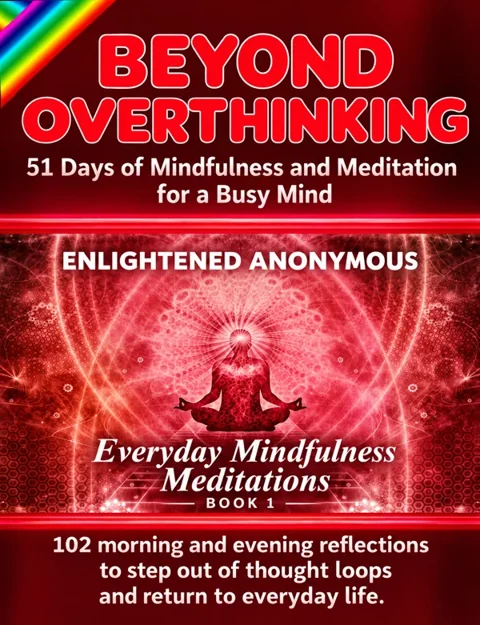
Everyday Mindfulness Meditations · Book 1
Beyond Overthinking
51 Days of Mindfulness and Meditation for a Busy Mind
51 days of mindfulness and meditation for repetitive worry, second-guessing and mental replay.
Read the first day → · Read or listen
About this book
When the same thought returns for the tenth time, what would help you respond differently? Beyond Overthinking offers 51 days of mindfulness and meditation for a busy mind. Through short morning practices and evening reflections, you will explore how to recognize repetitive thinking, return to the present moment, and respond to the concern beneath the loop.
Examples include replaying a conversation, anticipating someone's reaction, delaying a decision, or planning tomorrow when nothing more can be done tonight. Begin by noticing the difference between a question that needs attention and a question you keep revisiting without new information. From there, practice finding a reliable sensory anchor, describing what actually happened, and separating an observation from an assumption.
Each small experiment gives you something concrete to try while the larger question remains open. Inside, you will explore ways to: Recognize mental replay and identify an apology, boundary, question, or action that could help. Use contact with a surface, ordinary sounds, or a brief walk to bring attention back to your surroundings.
Distinguish preparation from repeated rehearsal and information from a demand for complete certainty. Make modest decisions with clear criteria, then learn from what happens next. Notice mind reading in relationships and ask a respectful question when clarification is possible.
Create a simple return plan for the moments when your thoughts become loud again. These practices are grounded in everyday life. You might give one bite of food your attention, name your purpose before opening an app, or write the useful lesson from a conversation instead of replaying every sentence.
You will also consider when recurring thought points toward an ordinary need such as rest, a difficult discussion, or a practical decision. The book contains 51 morning practices and 51 evening reflections. Allow a few minutes for each reading, try the practice in a suitable situation, and return to the questions later.
Write a brief note or reflect quietly. You can repeat, shorten, or adapt a practice. As the book progresses, the focus widens from recognizing loops to living alongside uncertainty.
You will explore unfinished tasks, reassurance, screen habits, boundaries, listening, and the stories that follow mistakes. Later entries help you select practices for quiet, busy, and difficult days so that your next step grows from experience rather than another demanding ideal. This book is for readers who recognize the strain of second-guessing, rehearsing, and mentally revisiting what cannot be changed.
It also welcomes meditation beginners who want clear, brief practices connected to real situations. Thinking can still be a valuable tool; the invitation is to notice when it serves understanding and when another round has stopped helping. The evening reflections give the morning experiment a second look.
Was there new information, or only a stronger urge to check? Did you need to solve the problem, ask someone, or leave it until a more useful time? This structure makes mindfulness for overthinking something you can examine in your own day, including the moments when the familiar loop returns.
For example, after a conversation, you can record the fact you know and the interpretation you added. If a repair is needed, choose an appropriate action. If nothing new is available, try returning to the room or the task at hand.
The question is whether another replay is helping you understand or keeping your attention tied to an imagined exchange.
Themes in this book
- Mindfulness for overthinking
- Stop replaying conversations
- Mental loops
- Decision worries
Read at your own pace
This volume is arranged as 51 days of morning practice and evening reflection. You can begin with one entry, try a manageable exercise, and return to the questions later. Repeat or adapt a day when that is useful.
Interested in a short practice first? Try a free written practice →
OPEN THE BOOK
Read the first day
A morning reading and its evening reflection.
DAY 1 · Morning
The moment thought becomes a loop
Remembered experience is not the present encounter. A thought loop can make yesterday's conversation seem to be happening again, although the other person is absent and the room has changed. The useful question is what the replay contributes now: evidence, preparation, or another attempt to obtain an answer from an event that has ended.
Think of a question you have revisited without learning anything new. Write it down once. Beside it, write: Is there a decision to make, information to seek, or action to take today? If there is, name one step. If there is not, call it a loop for now. Keep the note brief enough to consult when the question returns.
DAY 1 · Evening
The moment thought becomes a loop
When did the question return? Notice whether it arrived with fresh evidence or merely the familiar demand for certainty. You do not have to settle it tonight. Record one thing you did while the question remained open.
Explore the opening seven days
- The moment thought becomes a loop
- A thought is an event
- The cost of one more replay
- The observer's seat
- A worry with a job
- The first bodily signal
- A week without a score
Read or listen
Ebook
For your reading app or device.
Links coming soon
Paperback
A printed copy to keep close.
Links coming soon
Hardcover
A case-bound edition for your shelf.
Links coming soon
FROM READING TO EVERYDAY LIFE
Read. Pause. Practise. Reflect.
Take a passage into your day. This companion invitation is optional; you can adapt it or stop whenever you wish.
A little is enough.
Read the opening sample slowly. Choose one idea to consider rather than trying to retain everything.
Read the sample →Make room to notice.
Notice a thought, then notice one sound in the room.
Try it in context.
Explore a related practice, then notice whether anything feels useful in an ordinary moment.
Open the related practice →Keep your own question.
What changed when you stopped rehearsing for a moment?
Read and make an optional note →