 Meditation · Mindfulness · Enlightenment
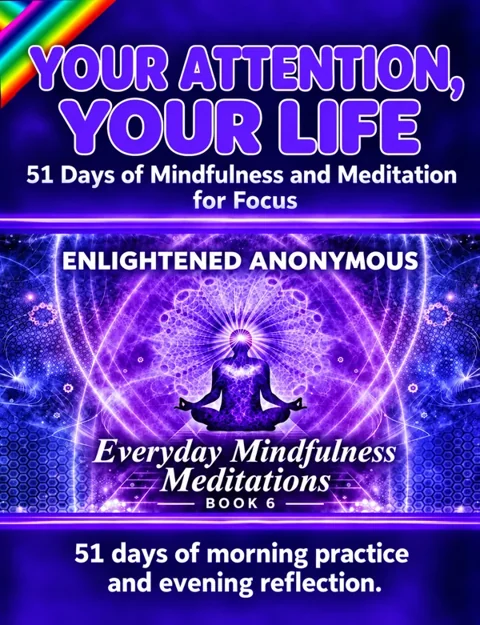
Everyday Mindfulness Meditations · Book 6
Your Attention, Your Life
51 Days of Mindfulness and Meditation for Focus
51 days of practice with concentration, digital distractions and everyday work habits.
Read the first day → · Read or listen
About this book
Your next hour will receive your attention. What do you want to give it to? Your Attention, Your Life offers 51 days of mindfulness and meditation for focus.
Through short morning practices and evening reflections, it explores distraction, concentration, digital habits, and the conditions that help you stay with a chosen task. The approach begins with something concrete: a page to read, a problem to examine, a conversation to hear, or a piece of work to begin. Attention becomes easier to examine when its object is clear.
You will practice naming the next visible action, noticing what competes for your interest, and returning without turning an interruption into a judgment about yourself. The book connects inner observation with practical arrangements, including your workspace, notifications, stopping points, energy, and agreements with other people. Inside, you will explore ways to: Begin a task at a useful scale and choose a workable interval for staying with it.
Notice the difference between gathering information and postponing the work itself. Set a purpose before opening a browser, starting a search, or accepting another input. Read closely, summarize what matters, and check understanding before relying on confidence.
Handle interruptions, switch tasks deliberately, and leave a clear mark for your return. Make room for creativity, chosen breaks, and the changing energy of an ordinary day. You might clear one surface, write down a competing thought, or decide where an online search will end.
A creative walk can have a question to carry. A conversation can become a practice in hearing before summarizing. Even a moment of waiting can reveal how quickly attention reaches for another source of stimulation.
The book contains 51 morning practices and 51 evening reflections. Allow a few minutes for each reading, try the practice in a suitable situation, and return to the questions later. Write a brief note or reflect quietly.
You can repeat, shorten, or adapt a practice. As the book progresses, you will examine the value beneath a task, the temptation to compare your output with someone else's, and the difference between depth and quantity. You will also explore unfinished ideas, returning after excess input, learning the difficult part of a subject, and making progress visible without constantly measuring yourself.
Focus is connected to purpose as well as persistence. Rest has a place in the process. A deliberate break can meet a real need, while an automatic diversion may leave you less clear about what you wanted.
The practices encourage you to notice that difference for yourself. You can adjust the task, the environment, or the timing, then observe whether the change supports attention in your actual circumstances. This book is for readers who want a more intentional relationship with their screens, work, learning, and creative projects.
It welcomes meditation beginners as well as readers looking to bring an existing practice into the working day. No elaborate productivity system is required. Start with an ordinary task and a willingness to learn how your attention behaves around it.
The evening reflections help you inspect the work period itself. Where did you leave the task? Which interruption needed a response, and which could wait?
Did a clearer first action make beginning easier? These are questions about your actual conditions for concentration, so you can keep a useful change without adopting someone else's ideal schedule. Your Attention, Your Life is Book 6 in Everyday Mindfulness Meditations by Enlightened Anonymous.
It can be read independently.
Themes in this book
- Mindfulness for focus
- Digital distraction
- Single task attention
- Concentration practice
Read at your own pace
This volume is arranged as 51 days of morning practice and evening reflection. You can begin with one entry, try a manageable exercise, and return to the questions later. Repeat or adapt a day when that is useful.
Interested in a short practice first? Try a free written practice →
OPEN THE BOOK
Read the first day
A morning reading and its evening reflection.
DAY 1 · Morning
Know the object
Intention gives attention a direction. An assignment described too broadly can hide several competing activities. You may think you are working on one project while repeatedly changing from research to revision to presentation. Naming the immediate object gives the interval a purpose you can recognize. It also makes a necessary change of purpose easier to notice.
Before beginning, state exactly what you intend to attend to: this paragraph, this calculation or this conversation. Focus becomes difficult to recognize when its object is vague.
DAY 1 · Evening
Know the object
What did you choose, and what counted as completing the next piece? Did the named object stay clear, or did the task change without a decision?
Explore the opening seven days
- Know the object
- Observe one work period
- The first visible action
- One clear surface
- Name the competing thought
- Choose a workable interval
- First-week evidence
Read or listen
Ebook
For your reading app or device.
Links coming soon
Paperback
A printed copy to keep close.
Links coming soon
Hardcover
A case-bound edition for your shelf.
Links coming soon
Audiobook
Take the reading with you.
Links coming soon
FROM READING TO EVERYDAY LIFE
Read. Pause. Practise. Reflect.
Take a passage into your day. This companion invitation is optional; you can adapt it or stop whenever you wish.
A little is enough.
Read the opening sample slowly. Choose one idea to consider rather than trying to retain everything.
Read the sample →Make room to notice.
Choose one small task and attend to its first movement.
Try it in context.
Explore a related practice, then notice whether anything feels useful in an ordinary moment.
Open the related practice →Keep your own question.
What helped you return to this task?
Read and make an optional note →