 Meditation · Mindfulness · Enlightenment
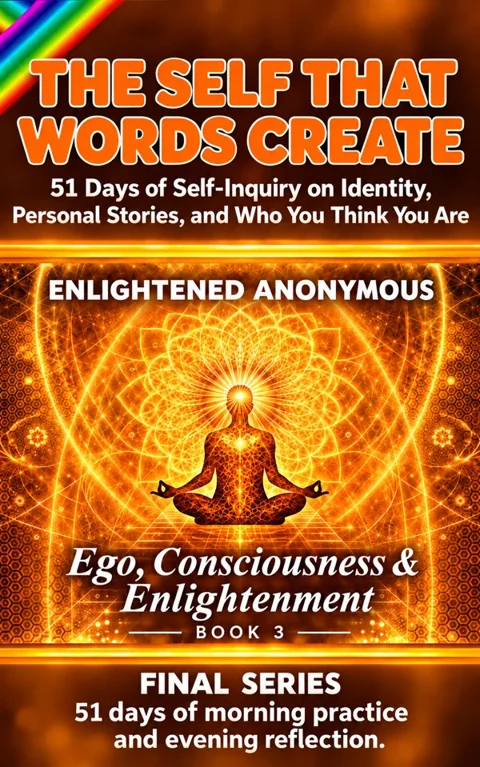
Ego, Consciousness & Enlightenment · FINAL SERIES · Book 3
The Self That Words Create
51 Days of Self-Inquiry on Identity, Personal Stories, and Who You Think You Are
51 days of self-inquiry on identity, names, roles and the stories used to describe a changing life.
Read the first day → · Read or listen
About this book
How much of who you are fits inside the words you use to describe yourself? The Self That Words Create offers 51 days of self-inquiry on identity, personal stories, and who you think you are. Its morning practices and evening reflections examine names, roles, status, and familiar descriptions: the language that helps you communicate a life and can also make a new experience answer to an old account.
A role may describe a responsibility accurately without containing the whole person. A story may preserve a meaningful experience while leaving later changes unseen. The book asks you to examine the usefulness and the limits of those descriptions.
You can keep language for practical purposes and make room for details that do not fit the first sentence about yourself. The seven weeks explore: Names and the parts of an experience they leave out. Roles, responsibilities, and the demand to remain consistent with an image.
Status and the wish to attach recognition to a contribution. Personal stories that organize memory and shape expectation. The difference between a particular mistake and a total verdict.
Language that makes a distinction clearer or hides one. Holding a description provisionally as circumstances change. Exercises begin with ordinary words: capable, shy, generous, successful, difficult.
What does a description help someone understand? When does it make you overlook a different response? You may consider an introduction, a new task, a contribution made without your name prominently attached, or a conversation in which a familiar story seems to have decided the outcome before you listen.
Self-inquiry into identity can reveal the pressure to prove a description. If you call yourself calm, a reaction may feel like a threat to the name. If you call yourself hopeless, an opportunity may be dismissed before you try.
The readings invite a more particular account of the occasion: what happened, what you did, and what remains possible now. Responsibility has a clear place in this inquiry. Naming a mistake and the repair it needs can be more useful than condemning your entire existence.
A broad judgment may sound serious while leaving the affected person waiting. A precise description keeps the action visible and gives you something to change without asking one event to define every part of your life. Each of the 51 days includes a morning practice and an evening reflection connected with that day's question.
The closing two days review what your descriptions helped you see and where they needed more room. Read slowly enough to try an exercise in a suitable situation. Selected spiritual discourse themes about naming, borrowed descriptions, and the self inform the readings.
The entries are original reflections and applications rather than translations or condensed discourse chapters. The book explores how language works in experience without requiring a final metaphysical answer about what the self is. This book suits readers interested in meditation on self-image, personal narratives, and the question of who they are beyond a familiar role.
The examples remain close to conversations, work, memories, and changes you can describe for yourself. A description can become more accurate when it leaves room for context. You may be confident in one setting, hesitant in another, and still learning in both.
You may introduce yourself for a practical purpose and let the rest emerge through contact. The inquiry allows a life to continue beyond the account already told about it. Book 3 in Ego, Consciousness & Enlightenment, The Self That Words Create can be read independently.
Themes in this book
- Identity and personal stories
- Self inquiry
- Labels and roles
- Who you think you are
Read at your own pace
This volume is arranged as 51 days of morning practice and evening reflection. You can begin with one entry, try a manageable exercise, and return to the questions later. Repeat or adapt a day when that is useful.
Interested in a short practice first? Try a free written practice →
OPEN THE BOOK
Read the first day
A morning reading and its evening reflection.
DAY 1 · Morning
Names
Choose a description you commonly use for yourself. What does it help someone understand, and what does it leave out? A name or role can be useful without containing the whole person. The source themes behind this inquiry concern borrowed descriptions and the limits of naming. Begin with an ordinary example. You need not abandon language to notice when a useful description becomes something you feel obliged to defend. A colleague may call you dependable because you kept a commitment. That description can acknowledge something real. It becomes restrictive if it means you must never need help or revise an agreement. Keep the evidence for the word and examine the added demand. The description can remain useful without governing every future occasion.
DAY 1 · Evening
Names
A description gave some actions a name and left others outside the account. Recall a particular occasion it described well beside one it missed; neither need settle your entire character. What did your chosen description include and omit?
Explore the opening seven days
- Names
- A name in context
- The label you inherited
- A useful introduction
- An unfamiliar description
- One word too broad
- The week's descriptions
Read or listen
Ebook
For your reading app or device.
Links coming soon
Paperback
A printed copy to keep close.
Links coming soon
Hardcover
A case-bound edition for your shelf.
Links coming soon
Audiobook
Take the reading with you.
Links coming soon
FROM READING TO EVERYDAY LIFE
Read. Pause. Practise. Reflect.
Take a passage into your day. This companion invitation is optional; you can adapt it or stop whenever you wish.
A little is enough.
Read the opening sample slowly. Choose one idea to consider rather than trying to retain everything.
Read the sample →Make room to notice.
Notice one color, one sound and the support beneath you.
Try it in context.
Explore a related practice, then notice whether anything feels useful in an ordinary moment.
Open the related practice →Keep your own question.
What was present before you began looking for a result?
Read and make an optional note →