 Meditation · Mindfulness · Enlightenment
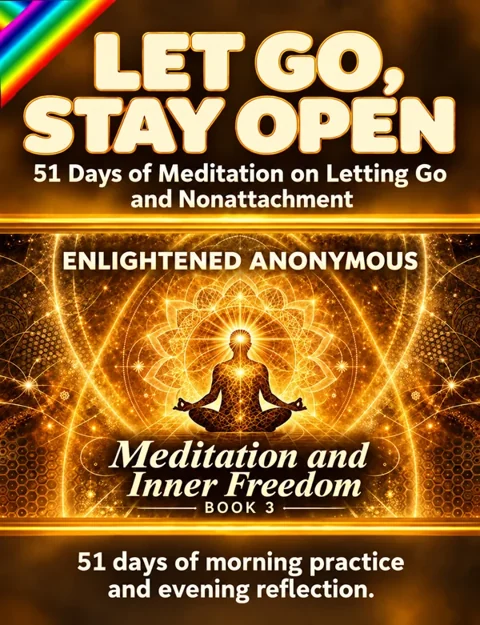
Meditation and Inner Freedom · Book 3
Let Go, Stay Open
51 Days of Meditation on Letting Go and Nonattachment
51 days of meditation on expectations, change and caring without control.
Read the first day → · Read or listen
About this book
What could change if you loosened one demand while continuing to care about what matters? Let Go, Stay Open offers 51 days of meditation on letting go and nonattachment. Through morning practices and evening reflections, it explores the expectations, possessions, outcomes, and identities that can become difficult to hold lightly.
The exercises ask which expectations help you act and which have become demands you cannot satisfy. Start small. Notice a preference, an object, or an outcome you keep trying to command.
Consider what is actually yours to choose and what remains beyond direct control. From there, the exercises move into ambition, relationships, endings, changing circumstances, and beliefs. Each day invites a practical distinction between responsible participation and an unnecessary demand that events unfold exactly as imagined.
Inside, you will explore ways to: Enjoy something without needing to own it, record it, or make it permanent. Recognize the stories attached to possessions, purchases, praise, and status. Give effort to a task while leaving room to learn from its outcome.
Offer advice, care, or a gift without requiring another person to respond as you hoped. Acknowledge an ending and make room for grief, support, and practical adaptation. Revise a plan or opinion when new information calls for a different response.
The daily examples keep nonattachment close to real experience. A collection can grow beyond its purpose. A plan can become less useful than the intention it was meant to serve.
An unanswered message can invite a demand that another person provide certainty. You will examine these moments and choose a modest experiment that fits the situation you are actually facing. The book contains 51 morning practices and 51 evening reflections.
Allow a few minutes for each reading, try the practice in a suitable situation, and return to the questions later. Write a brief note or reflect quietly. You can repeat, shorten, or adapt a practice.
Later entries consider the life you expected, the explanation you may never receive, the body as it changes, and the memory you want to keep. The exercises recognize that releasing a demand can coexist with disappointment or grief. You can seek care, preserve a meaningful connection, or make a necessary decision while acknowledging that some parts of the situation remain unresolved.
The later entries explore enough, the freedom to decline, the commitments worth keeping, and the habits of gripping that return in new forms. You will consider which responsibilities remain after a release and how to care for them more clearly. An open outcome still leaves room for a useful action, a safeguard, a question, or a revised agreement.
This book is for readers interested in a practical understanding of acceptance, impermanence, and emotional freedom. It welcomes those beginning a contemplative practice and those looking to bring familiar spiritual ideas into possessions, work, relationships, and change. You do not have to approve of an ending or feel peaceful about uncertainty before taking a thoughtful next step.
The evening reflections let you examine what changed after a small release. Did the responsibility remain clear? Could you enjoy a moment without trying to repeat it?
Did loosening an expectation make room for a different response? Daily meditation on nonattachment is explored through these details, including the situations in which disappointment remains. Let Go, Stay Open is Book 3 in Meditation and Inner Freedom by Enlightened Anonymous.
It can be read independently.
Themes in this book
- Letting go meditation
- Non attachment
- Accepting change
- Care without control
Read at your own pace
This volume is arranged as 51 days of morning practice and evening reflection. You can begin with one entry, try a manageable exercise, and return to the questions later. Repeat or adapt a day when that is useful.
Interested in a short practice first? Try a free written practice →
OPEN THE BOOK
Read the first day
A morning reading and its evening reflection.
DAY 1 · Morning
What are you holding?
Use and attachment need not be the same relationship. You can care for a home, an object, or a plan while remembering that its form can change. The practical question concerns the demand you place on it. Is it serving a purpose, or being asked to make your future secure in a way no arrangement can guarantee?
Name something you are holding tightly: an outcome, object, role or explanation. Ask what you fear would happen if your grip softened. Begin with an honest description.
DAY 1 · Evening
What are you holding?
What need sits beneath the grip? What would meet that need without requiring a guaranteed outcome? Name the need in ordinary language. Security, recognition, or company may deserve a direct response instead of another attempt to make an outcome certain.
Explore the opening seven days
- What are you holding?
- Care and command
- The preferred result
- The price of gripping
- Enjoy before owning
- A small release
- Review the grip
Read or listen
Ebook
For your reading app or device.
Links coming soon
Paperback
A printed copy to keep close.
Links coming soon
Hardcover
A case-bound edition for your shelf.
Links coming soon
FROM READING TO EVERYDAY LIFE
Read. Pause. Practise. Reflect.
Take a passage into your day. This companion invitation is optional; you can adapt it or stop whenever you wish.
A little is enough.
Read the opening sample slowly. Choose one idea to consider rather than trying to retain everything.
Read the sample →Make room to notice.
Notice a thought, then notice one sound in the room.
Try it in context.
Explore a related practice, then notice whether anything feels useful in an ordinary moment.
Open the related practice →Keep your own question.
What changed when you stopped rehearsing for a moment?
Read and make an optional note →