 Meditation · Mindfulness · Enlightenment
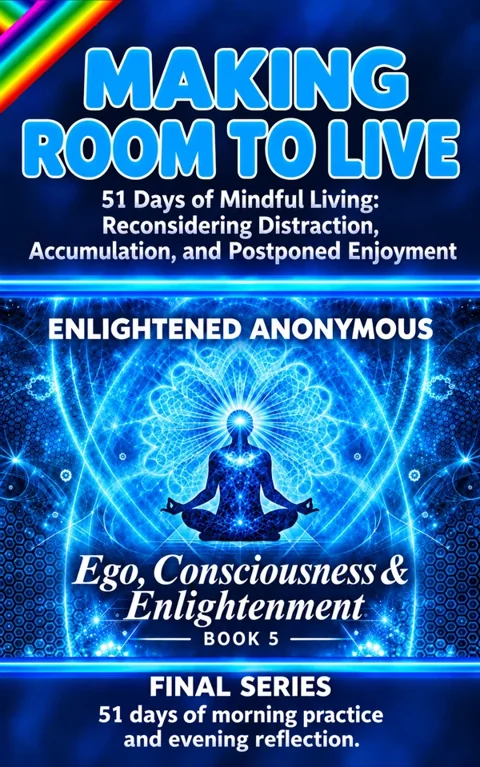
Ego, Consciousness & Enlightenment · FINAL SERIES · Book 5
Making Room to Live
51 Days of Mindful Living: Reconsidering Distraction, Accumulation, and Postponed Enjoyment
51 days of mindful living on distraction, accumulation and making room for what matters.
Read the first day → · Read or listen
About this book
A life can be full of things and plans while the experience of living keeps waiting. Making Room to Live offers 51 days of mindful living focused on distraction, accumulation, and postponed enjoyment. Morning practices and evening reflections examine what occupies your time and attention, what those occupations serve, and which worthwhile experiences remain indefinitely scheduled for a better day.
The book recognizes that life can be busy for good reasons. Resources may be needed, responsibilities may be real, and preparation may help you act. The question is what an addition makes possible in your actual circumstances.
Another item, another explanation, or another commitment may serve a purpose; it may also stand in for using what is already available. Across seven weeks, the readings examine: Accumulating possessions, information, obligations, and plans. Occupied time and the difference between use and repeated checking.
Postponed living and the conditions you require before beginning. Empty intervals and the urge to fill them immediately. Habitual preoccupations that return without new information.
Sensitivity to the people, tasks, and pleasures already present. What deserves a practical place in the day you have. An exercise may begin with something you keep adding to.
What did the latest addition enable, and what did it promise? Another asks whether checking a page or message again will provide information you do not yet have. If the answer is no, the urge may concern reassurance.
Noticing that difference gives you a more precise need to consider. Mindful living also includes enjoyment within an unfinished day. You may listen to one song, sit outside, or take time with a drink without requiring the pleasure to compensate for everything difficult.
A modest experience can be real before work is complete or circumstances are ideal. The readings help you notice how often participation is delayed until an imagined future has been arranged. The book approaches making room through purpose.
A possession may be useful and worth keeping; a commitment may matter even when it is demanding. Less is not automatically better. The practices ask what an arrangement supports, what it displaces, and whether its costs are still worthwhile.
A clear priority can involve using a resource, refusing an addition, or giving an existing relationship more attention. Each of the 51 days includes a morning practice and an evening reflection on the same inquiry. Seven weeks are followed by two review days to help you choose what deserves continuing attention.
Read at a workable pace, try a small exercise, and return to what happened. Some readings examine a gap that usually leads straight to a screen or another plan. Others ask about a postponed conversation, a neglected task, or a need for recovery.
The evening questions return to these occasions with room for mixed results. An interval may still feel restless, and a responsibility may still need doing; the observation can nevertheless clarify what the next action should serve. Selected spiritual discourse themes about accumulation, occupied attention, and participation in life supply the starting questions.
The entries are original reflections and exercises, not translations or condensed discourse chapters. This book suits readers interested in reducing constant distraction, examining habitual checking, and making room for what matters without imposing a rule of minimalism. Book 5 in Ego, Consciousness & Enlightenment, Making Room to Live can be read independently.
Themes in this book
- Mindful living
- Information overload
- Using what you have
- Postponed enjoyment
Read at your own pace
This volume is arranged as 51 days of morning practice and evening reflection. You can begin with one entry, try a manageable exercise, and return to the questions later. Repeat or adapt a day when that is useful.
Interested in a short practice first? Try a free written practice →
OPEN THE BOOK
Read the first day
A morning reading and its evening reflection.
DAY 1 · Morning
Accumulation
Choose something you keep adding to: possessions, information, obligations, or plans. What purpose does the addition serve? A useful resource can be accumulated wisely; a growing collection can also substitute for using what is already available. Examine one recent addition. Ask what it enabled and what it promised. This book concerns what occupies a life, not a rule that fewer possessions make a person spiritually better. Consider an unread book bought for a real interest. Keeping it may still make sense, but its presence is not the same as meeting the subject through reading. Ask whether the next useful step is another purchase or opening the book. The answer concerns this resource and this interest, not a moral judgement about everything you own.
DAY 1 · Evening
Accumulation
The addition brought a particular resource or commitment into your life. Compare its actual use with the promise that drew you, including any ordinary benefit rather than demanding that it settle every larger wish. What did the addition actually make possible?
Explore the opening seven days
- Accumulation
- Something already available
- Information without application
- The next addition promised
- A collection you enjoy
- More than you can use
- The purpose of adding
Read or listen
Ebook
For your reading app or device.
Links coming soon
Paperback
A printed copy to keep close.
Links coming soon
Hardcover
A case-bound edition for your shelf.
Links coming soon
Audiobook
Take the reading with you.
Links coming soon
FROM READING TO EVERYDAY LIFE
Read. Pause. Practise. Reflect.
Take a passage into your day. This companion invitation is optional; you can adapt it or stop whenever you wish.
A little is enough.
Read the opening sample slowly. Choose one idea to consider rather than trying to retain everything.
Read the sample →Make room to notice.
Choose one small task and attend to its first movement.
Try it in context.
Explore a related practice, then notice whether anything feels useful in an ordinary moment.
Open the related practice →Keep your own question.
What helped you return to this task?
Read and make an optional note →