 Meditation · Mindfulness · Enlightenment
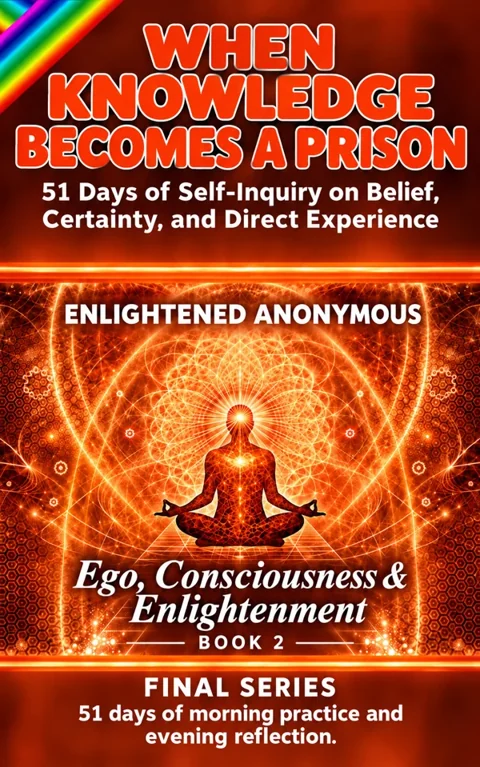
Ego, Consciousness & Enlightenment · FINAL SERIES · Book 2
When Knowledge Becomes a Prison
51 Days of Self-Inquiry on Belief, Certainty, and Direct Experience
51 days of self-inquiry on borrowed knowledge, certainty and direct experience.
Read the first day → · Read or listen
About this book
Knowing a teaching well does not settle what you have understood through experience. When Knowledge Becomes a Prison offers 51 days of self-inquiry on belief, certainty, and direct experience. Morning practices and evening reflections examine how you acquire information, use it, defend it, and revise it.
The book gives knowledge a useful place while questioning the conclusions you may make too quickly in its name. Information from reading or instruction can guide a real action. Direct experience may establish something else, and neither necessarily answers every question surrounding it.
The readings invite you to notice which parts of an account you can support, which you have borrowed, and which remain an interpretation. A confident explanation becomes easier to assess when those parts are kept visible. Across seven weeks, you will explore: Information and experience, including what each can establish.
Borrowed assurance and the comfort of a familiar explanation. Authority, quotations, and the importance of context. Debate that clarifies a question or defends a position.
Honest uncertainty and the words needed to describe it. Modest trials that put an understanding to use. Revising a claim while preserving what remains valuable.
One exercise begins with a subject you discuss confidently. Which parts come from instruction, and which from something you have done or observed? Another asks you to read the surrounding paragraph before using a quotation.
Context may complicate a sentence that seemed to support your view; noticing that complication gives the source a fairer hearing. Self-inquiry also follows the wish to appear knowledgeable. A conversation can become a contest before the question is clear.
A fact can be accurate while its use is careless. The readings ask you to consider the purpose of an exchange: helping someone understand, solving a practical problem, or maintaining your place as the person who knows. There is room for decisions made under limits.
Sometimes an action is needed before the explanation is complete. You can use the information available, state an uncertainty, and choose a point for review. The practice is to make that judgment honestly rather than turning a provisional choice into proof that the larger question has been settled.
The book contains 51 morning practices and 51 evening reflections, arranged through seven weeks and two closing review days. Each evening returns to the particular claim, conversation, or trial you considered that day. The reflections develop original exercises from selected spiritual discourse themes about borrowed understanding, certainty, and experience.
They are not translations or a complete account of a teacher's philosophy. This book suits readers interested in questioning spiritual beliefs carefully, examining direct experience, and bringing more precision to self-inquiry. It may accompany a meditation practice, a reading group, or study that has raised difficult questions about authority.
You do not need to discard learning to begin; you need a claim specific enough to examine. Revising an explanation need not erase everything you learned. You may keep a useful instruction while narrowing the promise made for it.
You may value a teacher while questioning the reach of a particular assertion. The closing readings return knowledge to a practical purpose: helping you understand and respond to a real situation with care. Book 2 in Ego, Consciousness & Enlightenment, When Knowledge Becomes a Prison can be read on its own.
Themes in this book
- Belief versus experience
- Spiritual certainty
- Questioning borrowed knowledge
- Self inquiry
Read at your own pace
This volume is arranged as 51 days of morning practice and evening reflection. You can begin with one entry, try a manageable exercise, and return to the questions later. Repeat or adapt a day when that is useful.
Interested in a short practice first? Try a free written practice →
OPEN THE BOOK
Read the first day
A morning reading and its evening reflection.
DAY 1 · Morning
Information and experience
Choose a subject you can discuss confidently. Which parts of your knowledge come from reading or instruction, and which from direct experience? Both can be useful, but they establish different things. Write one claim you can support and one you repeat without knowing its basis. This inquiry questions premature certainty. It does not require discarding learning or pretending that every fact must be discovered personally. A person can learn a useful instruction from someone else before having experience with it. Trying the instruction may reveal difficulties the explanation did not mention. These forms of learning can support each other. Neither repeating the instruction fluently nor having one strong experience gives you unlimited authority about its meaning.
DAY 1 · Evening
Information and experience
Confidence may have joined reading, experience, and inference without distinguishing them. Put one claim beside its actual basis tonight; the distinction can make useful knowledge more precise rather than less welcome. Where did your confidence exceed your basis?
Explore the opening seven days
- Information and experience
- A useful fact
- A borrowed description
- Experience with a limited scope
- Familiar terminology
- Knowing how to begin
- Your present basis
Read or listen
Ebook
For your reading app or device.
Links coming soon
Paperback
A printed copy to keep close.
Links coming soon
Hardcover
A case-bound edition for your shelf.
Links coming soon
Audiobook
Take the reading with you.
Links coming soon
FROM READING TO EVERYDAY LIFE
Read. Pause. Practise. Reflect.
Take a passage into your day. This companion invitation is optional; you can adapt it or stop whenever you wish.
A little is enough.
Read the opening sample slowly. Choose one idea to consider rather than trying to retain everything.
Read the sample →Make room to notice.
Notice one color, one sound and the support beneath you.
Try it in context.
Explore a related practice, then notice whether anything feels useful in an ordinary moment.
Open the related practice →Keep your own question.
What was present before you began looking for a result?
Read and make an optional note →