 Meditation · Mindfulness · Enlightenment
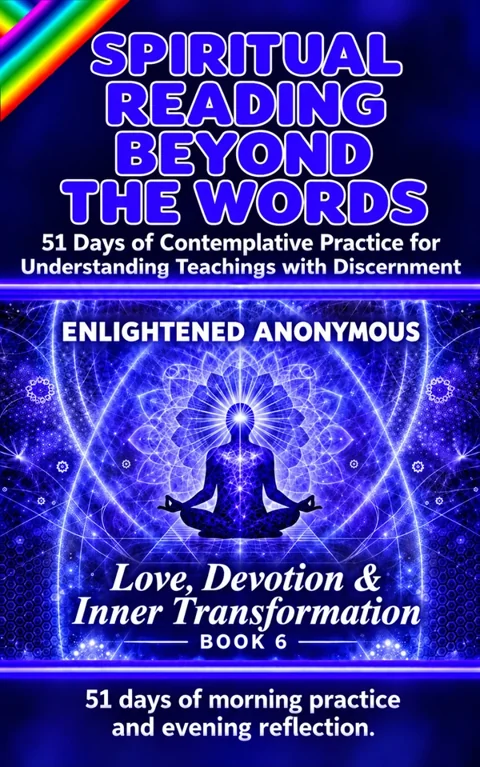
Love, Devotion & Inner Transformation · Book 6
Spiritual Reading Beyond the Words
51 Days of Contemplative Practice for Understanding Teachings with Discernment
51 days of contemplative practice on spiritual reading, interpretation and understanding.
Read the first day → · Read or listen
About this book
A remembered phrase is only the beginning of understanding a spiritual teaching. Spiritual Reading Beyond the Words offers 51 days of contemplative practice for understanding teachings with discernment. Morning exercises and evening reflections follow the experience of reading, listening, interpreting, and trying an idea in ordinary life.
They make room for appreciation, disagreement, and questions that a passage has not yet answered. You may approach a book seeking instruction, reassurance, an explanation, or language for something you have experienced. Knowing that starting question can help you judge what the reading offers.
The question may change as you read. You do not have to make a single passage answer every concern that brought you to it. Across seven weeks, the book explores: Arriving at a passage with a particular question.
Slow reading and the words you normally hurry past. Rereading a familiar text without assuming its meaning is settled. Context, metaphor, interpretation, and the limits of a claim.
Asking honest questions without performing your knowledge. Trying a modest application and observing what follows. Continuing to read with appreciation and independent judgment.
One exercise asks you to read the sentences around a quotation before relying on it. Another invites you to return to a familiar passage when your mood or situation has changed. You may discover that the surrounding argument complicates a saying you thought you understood, or that the text answers one part of your question while leaving another untouched.
Contemplative reading can include close attention to disagreement. What exactly do you find convincing? Which conclusion goes beyond the reasons given?
What might be an image rather than a factual assertion? These distinctions let you receive something useful without pretending that every part of a teaching has become clear or acceptable. The practices connect reading with conduct.
You might choose one small suggestion to try, describe what happened, and reconsider an interpretation in light of the result. An exercise can be worthwhile without proving the entire philosophy behind it. Separating what a text says, what you think it means, and what your trial establishes gives each a more accurate place.
Listening matters too. A question asked to clarify an experience differs from a question used to display learning. An incomplete answer may contribute something real.
The entries invite you to hear that contribution before deciding what to ask next, keeping the exchange specific enough that uncertainty can be named rather than concealed. Each of the 51 days contains a morning practice and an evening reflection on the same inquiry. Seven weeks conclude with two review days.
Read at a manageable pace, use a suitable passage or conversation, and keep brief notes separately if you wish. Selected spiritual discourse themes about understanding, listening, and borrowed language supply the starting questions. The entries are original reflections and applications, not translations or condensed chapters.
The book offers a way to examine teachings rather than an anthology of sacred texts or a complete explanation of a tradition. This book suits readers interested in spiritual reading, contemplative study, and applying wisdom with discernment. It may accompany a reading group or a personal meditation practice, especially when familiar phrases feel easier to repeat than to explain.
You can value a source and still need further context, a clearer argument, or time to consider its claims.
Themes in this book
- Contemplative reading practice
- Understanding spiritual teachings
- Reading with discernment
- Morning and evening meditation
Read at your own pace
This volume is arranged as 51 days of morning practice and evening reflection. You can begin with one entry, try a manageable exercise, and return to the questions later. Repeat or adapt a day when that is useful.
Interested in a short practice first? Try a free written practice →
OPEN THE BOOK
Read the first day
A morning reading and its evening reflection.
DAY 1 · Morning
What brought you to this page
A spiritual text is easier to examine when you know what brought you to it. Perhaps you seek relief, instruction, an explanation, or words for an experience. Write the particular question before reading more. The question may change, but it gives you something against which to judge what you receive. You need not make the reading answer every concern in your life.
DAY 1 · Evening
What brought you to this page
Recall the need that brought you to the page and what the passage actually offered. Comfort, instruction, and confirmation are different gifts; the reading may have supplied one while leaving another need untouched. What did you actually seek, and what did you find?
Explore the opening seven days
- What brought you to this page
- The answer you hoped to find
- A question from experience
- Your expectation of the author
- Preparing a rebuttal
- Interest without agreement
- Worth a second reading
Read or listen
Ebook
For your reading app or device.
Links coming soon
Paperback
A printed copy to keep close.
Links coming soon
Hardcover
A case-bound edition for your shelf.
Links coming soon
Audiobook
Take the reading with you.
Links coming soon
FROM READING TO EVERYDAY LIFE
Read. Pause. Practise. Reflect.
Take a passage into your day. This companion invitation is optional; you can adapt it or stop whenever you wish.
A little is enough.
Read the opening sample slowly. Choose one idea to consider rather than trying to retain everything.
Read the sample →Make room to notice.
Notice one color, one sound and the support beneath you.
Try it in context.
Explore a related practice, then notice whether anything feels useful in an ordinary moment.
Open the related practice →Keep your own question.
What was present before you began looking for a result?
Read and make an optional note →