 Meditation · Mindfulness · Enlightenment
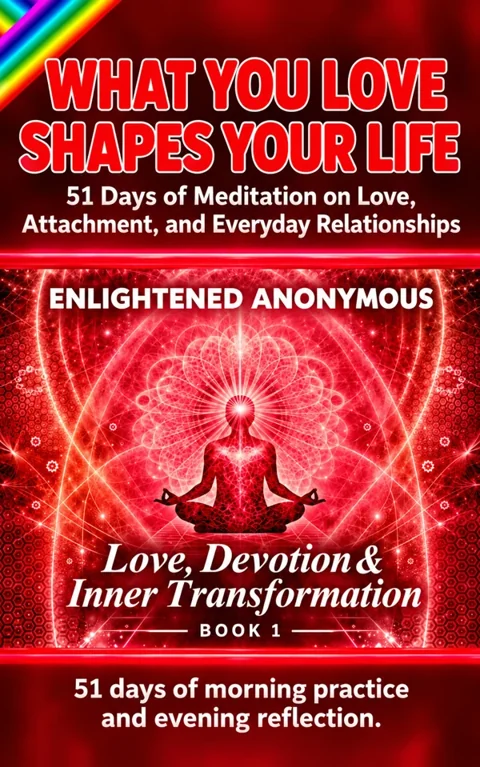
Love, Devotion & Inner Transformation · Book 1
What You Love Shapes Your Life
51 Days of Meditation on Love, Attachment, and Everyday Relationships
51 days of reflection on love, attachment, expectations and everyday relationships.
Read the first day → · Read or listen
About this book
What does love look like in the choices of an ordinary day? What You Love Shapes Your Life offers 51 days of meditation on love, attachment, and everyday relationships. Its morning practices and evening reflections begin with familiar situations: waiting for recognition, appreciating a person's care, wanting an affection returned, or discovering that what you pursue does not quite match what you value.
The book asks you to look closely at affection without reducing it to a single ideal. Love can include pleasure, responsibility, hope, irritation, and the wish to be important to someone. Seeing those different motives can make an act of care more specific and an expectation easier to discuss.
You do not have to produce a perfectly selfless feeling before paying attention to another person's needs. Across the seven weeks, you will explore: What your choices reveal about the direction of your affection. The difference between enjoying an activity and seeking the identity it promises.
Appreciation that describes what someone actually did. Admiration, idealization, and the wish to possess what you love. Care for people, places, and work without ignoring their real conditions.
Gratitude, generosity, and expectations that deserve an honest conversation. Giving affection a workable place in the life you already have. The exercises bring these questions into small occasions.
You might compare the things you say you love with what received your attention yesterday. A responsibility can demand time without revealing your deepest preference, so the comparison invites inquiry rather than a quick verdict. On another day, you may offer a precise appreciation, listen to an answer you did not expect, or notice the imagined reward attached to a generous gesture.
Love and attachment are examined through their effects. Does a wish for closeness leave room for the other person's response? Has admiration made it difficult to see their limits?
Can an act of care continue when it brings little recognition? The entries allow mixed answers. They make room for an affection that matters and an expectation that needs to change, rather than requiring you to call the whole relationship good or bad.
Each of the 51 days contains a morning reading with an original practice and an evening reflection that returns to the day's particular question. Read a little, try a suitable exercise, and come back to what happened. The final two days help you review what you noticed and choose an act of care worth continuing.
The readings draw on selected spiritual discourse themes about affection, possessiveness, and devotion. They develop those questions into original everyday exercises; they are not translations or condensed discourse chapters. This book suits readers interested in meditation for relationships, thoughtful spiritual growth, and daily reflection on how love becomes conduct.
It can accompany an existing practice or offer a manageable way to begin examining familiar reactions. The language stays close to ordinary experience: a conversation, a task, a place you care about, or a kindness received. There is room here for boundaries and disappointment as well as warmth.
Giving someone freedom does not require agreeing to every request; generosity need not conceal an unspoken bargain. A question about love becomes useful when it helps you notice the person or situation before you, including what you can offer and what you need to say plainly. Book 1 in Love, Devotion & Inner Transformation, What You Love Shapes Your Life can be read independently.
Themes in this book
- Love without possessiveness
- Attachment and affection
- Approval seeking
- Mindful relationships
Read at your own pace
This volume is arranged as 51 days of morning practice and evening reflection. You can begin with one entry, try a manageable exercise, and return to the questions later. Repeat or adapt a day when that is useful.
Interested in a short practice first? Try a free written practice →
OPEN THE BOOK
Read the first day
A morning reading and its evening reflection.
DAY 1 · Morning
The answer your day gives
Write three things you say you love. Then look at yesterday: what repeatedly received your attention? Include the thing you checked without needing to, the conversation you rehearsed, and the work you stayed with willingly. Attention alone does not prove love; a pressing responsibility may require it. Still, the difference between your stated affections and your actual day is worth examining. Choose one difference to observe today before explaining it away.
DAY 1 · Evening
The answer your day gives
What received attention because it mattered to you, and what received it through urgency or habit? Keep one example of each. Did your choices reveal an affection you had not included in the morning list? An accurate answer can contain obligations and mixed motives without becoming an accusation against yourself.
Explore the opening seven days
- The answer your day gives
- What your affection asks you to become
- Enjoyment before the story
- Affection and a practical need
- What you would protect
- The affection you have not named
- Your first map of affection
Read or listen
Ebook
For your reading app or device.
Links coming soon
Paperback
A printed copy to keep close.
Links coming soon
Hardcover
A case-bound edition for your shelf.
Links coming soon
FROM READING TO EVERYDAY LIFE
Read. Pause. Practise. Reflect.
Take a passage into your day. This companion invitation is optional; you can adapt it or stop whenever you wish.
A little is enough.
Read the opening sample slowly. Choose one idea to consider rather than trying to retain everything.
Read the sample →Make room to notice.
Listen to one ordinary sound without preparing a response.
Try it in context.
Explore a related practice, then notice whether anything feels useful in an ordinary moment.
Open the related practice →Keep your own question.
What did you hear before adding an interpretation?
Read and make an optional note →