 Meditation · Mindfulness · Enlightenment
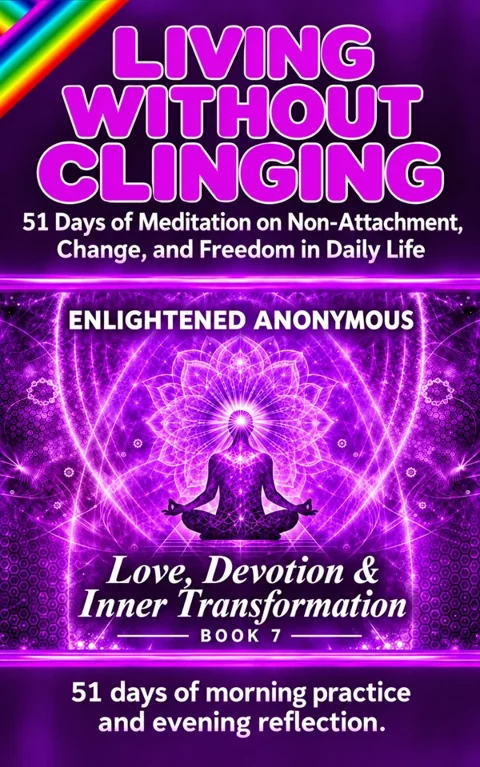
Love, Devotion & Inner Transformation · Book 7
Living Without Clinging
51 Days of Meditation on Non-Attachment, Change, and Freedom in Daily Life
51 days of meditation on non-attachment, change and participation in everyday life.
Read the first day → · Read or listen
About this book
A support can help you live and still become something you demand must never change. Living Without Clinging offers 51 days of meditation on non-attachment, change, and freedom in daily life. Morning practices and evening reflections examine homes, routines, relationships, and agreements: the arrangements that support participation and the expectations that can make them difficult to adapt.
The book begins by recognizing the value of support. A familiar place may help you rest; a routine may make work possible; a relationship may offer real care. These benefits deserve attention.
The inquiry asks what happens when a helpful arrangement becomes a condition you insist life must preserve in every detail. The seven weeks explore: The practical supports you need and what they enable. When a support becomes a rigid condition.
Control within belonging, shared plans, and agreements. Staying or leaving with attention to the actual situation. Making room for what has changed.
Ordinary difficulty and the additional struggle created by insistence. Participating with care while allowing more than one workable arrangement. The exercises use particular occasions.
You may describe what a place enables before deciding what it means to you. If a shared plan changes, you may identify the inconvenience, ask what happened, and consider what can be arranged now. A broken commitment can require a serious conversation; changed circumstances may require a different response.
Clinging can make both sound like the same accusation. Non-attachment is examined through how you act. Can a routine have a shorter version?
Can a meeting move without losing its purpose? Can you remember a valued time without requiring the present to repeat it? These questions allow care to remain while a particular demand is reconsidered.
You can preserve something important and make its arrangement less brittle. Other readings consider belonging and responsibility. A shared home or friendship may involve genuine obligations, preferences, and limits.
Letting go does not settle those matters automatically. The book encourages clear requests, practical decisions, and attention to another person's answer. Freedom becomes a question about participation, including what you can offer and what needs discussion.
Each day includes a morning practice and an evening reflection that returns to the day's specific inquiry. The 51-day sequence contains seven weeks and two closing review days. Read a little, try an exercise that fits, and come back to the details of what followed.
The readings also ask how you continue after a change. A useful support may need repair, replacement, or a flexible alternative. You may need to grieve a loss of familiarity or make a new agreement.
The practices do not rush those responses. They help you examine what the current situation requires rather than measuring it only against the arrangement you expected. Selected spiritual discourse themes about clinging, ordinary supports, and participation supply the starting questions.
These are original reflections and exercises rather than translations or condensed discourse chapters. This book suits readers interested in letting go without becoming indifferent, meditation on change, and non-attachment in relationships and daily routines. It can accompany an existing practice or a period when familiar arrangements are changing.
The approach stays practical enough to examine through one plan, one request, or one adjustment at a time. Book 7 in Love, Devotion & Inner Transformation, Living Without Clinging can be read independently.
Themes in this book
- Non attachment in daily life
- Clinging to routines
- Change and belonging
- Freedom to respond
Read at your own pace
This volume is arranged as 51 days of morning practice and evening reflection. You can begin with one entry, try a manageable exercise, and return to the questions later. Repeat or adapt a day when that is useful.
Interested in a short practice first? Try a free written practice →
OPEN THE BOOK
Read the first day
A morning reading and its evening reflection.
DAY 1 · Morning
A place that helps you recover
A support can serve life without becoming its final purpose. Choose a place or arrangement that helps you rest, work, or recover. Describe what it actually enables. The source question behind this book includes ordinary homes and relations without condemning them. It asks what happens when useful support becomes something we insist must remain unchanged. Begin with its value before examining your attachment.
DAY 1 · Evening
A place that helps you recover
A valued support enabled something beyond its own preservation. Recall the rest, work, or participation it made possible; that purpose provides a useful starting point for examining your attachment to it. What did this support enable today?
Explore the opening seven days
- A place that helps you recover
- Rest for participation
- Practical support
- Caring for what you use
- A limited purpose
- Comfort without permanence
- A support serving its purpose
Read or listen
Ebook
For your reading app or device.
Links coming soon
Paperback
A printed copy to keep close.
Links coming soon
Hardcover
A case-bound edition for your shelf.
Links coming soon
Audiobook
Take the reading with you.
Links coming soon
FROM READING TO EVERYDAY LIFE
Read. Pause. Practise. Reflect.
Take a passage into your day. This companion invitation is optional; you can adapt it or stop whenever you wish.
A little is enough.
Read the opening sample slowly. Choose one idea to consider rather than trying to retain everything.
Read the sample →Make room to notice.
Listen to one ordinary sound without preparing a response.
Try it in context.
Explore a related practice, then notice whether anything feels useful in an ordinary moment.
Open the related practice →Keep your own question.
What did you hear before adding an interpretation?
Read and make an optional note →